
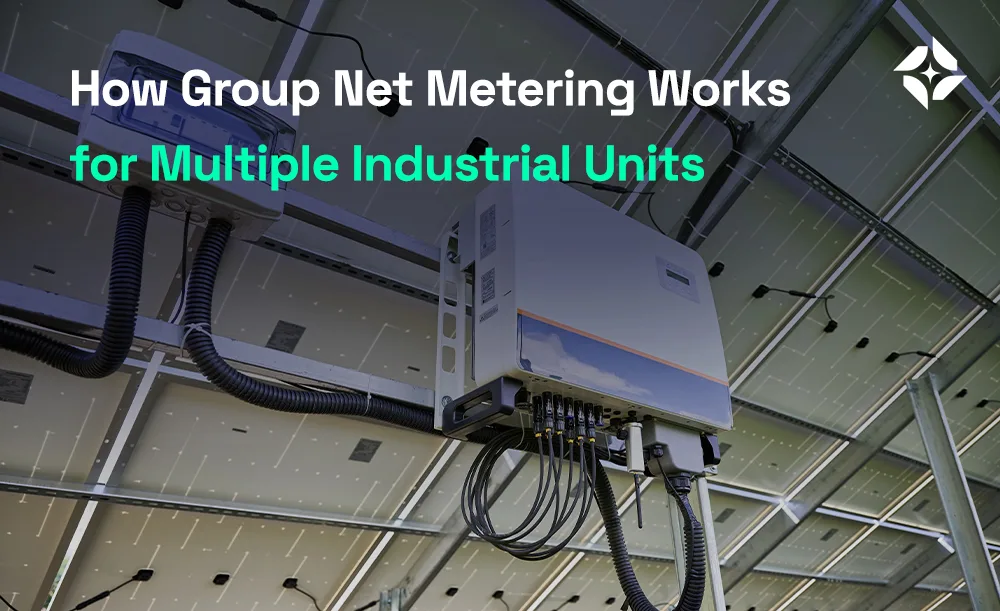
Many business owners in India face a common problem. They have several factories or buildings, but only one of them has enough space for a large solar system. In the past, this meant only one building could save money on power. Today, things have changed. Group Net Metering for industrial units allows a company to build one big solar plant and share the electricity credits across all its different locations. This is a game-changer for the industrial sector.
What is Group Net Metering?
Group net metering is a billing system that lets you connect one solar energy project to multiple electricity connections. Instead of putting solar panels on every single roof, you put them in one place where there is plenty of room. The energy produced there is sent to the power grid. Then, the local utility company gives you credits on your electricity bills for your other factories. It is essentially a way of sharing solar energy sharing multiple units without needing wires to connect the buildings directly.
How Group Net Metering Works for Industrial Units
Understanding the step-by-step process helps you see why it is so effective for large businesses. It starts with a central location and ends with lower bills at every factory gate.
Solar Power Generation at Central Plant
First, a large solar plant is built. This can be a rooftop system on your biggest warehouse or a Ground Mount Solar project on empty land you own. This central plant creates a lot of clean electricity from the sun. Because it is all in one spot, it is much easier to clean and maintain than many small systems scattered around.
Export of Energy to the Grid
Once the panels produce electricity, the power is sent straight into the government electricity grid. A special meter, called a bidirectional meter, tracks exactly how many units of power you are sending out. This makes your solar plant act like a mini power station for the community.
Energy Credit Recording by Utility
In places like India, the local DISCOM (utility company) keeps a record of this exported energy. If your plant sends 10,000 units to the grid, the utility company puts those units into a ‘virtual bank.’ They keep track of these credits every month.
Credit Allocation to Multiple Factories
This is the best part. You can tell the utility company to split those 10,000 units among your other factories. For example, if you have three factories, you can give 4,000 units to the first, 3,000 to the second, and 3,000 to the third. This is why it is often called group net metering multiple factories.
Key Benefits for Industrial Groups
Using Group net metering C&I solar (Commercial and Industrial) offers many perks. First, you get significantly reduced electricity costs across your whole business. Instead of paying high industrial rates for every unit, you use your own solar credits.
Second, it ensures maximum utilization of solar power. You don’t have to worry if one factory is closed for a day; its credits can simply go to another factory that is working overtime. Also, there is no need for individual solar plants at every site. This saves you from the headache of maintaining panels on old roofs that might not be strong enough. All of this leads to a much better ROI for industrial solar owners.
Group Net Metering Rules in Gujarat
If your business is located in western India, you must follow the specific Group net metering Gujarat policies. To start, you need DISCOM approval. Usually, all the electricity connections must be under the same legal name or entity. There are also capacity and load limitations. For example, the solar plant’s size is often tied to the total ‘sanctioned load’ of all your units combined. The billing and credit adjustment rules in Gujarat are very specific about how much money they pay you for extra units left over at the end of the year.
Process to Implement Group Net Metering
Setting this up takes a few professional steps. First, you need a feasibility study and load analysis. This means checking how much power you use at every site. Next comes the DISCOM application and approval process, which involves a lot of paperwork to prove you own the factories. Once approved, the Industrial solar plant installation and meter setup begin. Finally, you set up the credit allocation configuration so the utility knows exactly how to split the savings.
Challenges in Group Net Metering
It is not always simple. Regulatory approvals can take time and involve many government offices. Sometimes, the grid capacity in your area might be limited, meaning the utility cannot take all the power your plant wants to send. Also, managing the credit-sharing complexity requires careful accounting to make sure every unit is billed correctly.
Why Choose Raynex Power Solution for Group Net Metering Projects
At Raynex Power Solution, we specialize in complex energy projects. We understand the technical side of Commercial Solar and the legal side of net metering laws. Whether you need a large rooftop array or a Ground Mount Solar farm, we handle everything from the first design to the final government approval. We make sure your virtual net metering industry setup is optimized to save you the most money possible.
Conclusion
Group Net Metering for industrial units is the smartest way for modern companies to go green and save money. By centralizing your solar power, you cut costs and simplify your energy management. If you are ready to stop paying high energy bills for your multiple locations, contact Raynex Power Solution today to see how we can help you power your future.
FAQs
What is the difference between GNM and Virtual Net Metering?
Group Net Metering (GNM) is usually for locations owned by the same person or company within the same utility area. Virtual Net Metering often allows different people, like apartment renters, to share credits from one solar plant.
Can multiple factories share one solar plant?
Yes, through group net metering, one central solar plant can provide electricity credits to multiple factories as long as they are under the same electricity distribution company (DISCOM) and meet ownership rules.
Is Group Net Metering allowed in all states?
No, it depends on state-specific policies. States like Gujarat, Delhi, and Karnataka have specific rules for GNM. You should check your local state electricity board regulations.
How is billing done in GNM?
The utility company tracks the power generated by the solar plant. They then subtract those units from the electricity bills of your various industrial units based on a percentage you decide beforehand.
Can new units be added later?
Usually, yes. You can update your agreement with the DISCOM to add new electricity connections to your group net metering plan, provided you stay within the allowed capacity limits.