
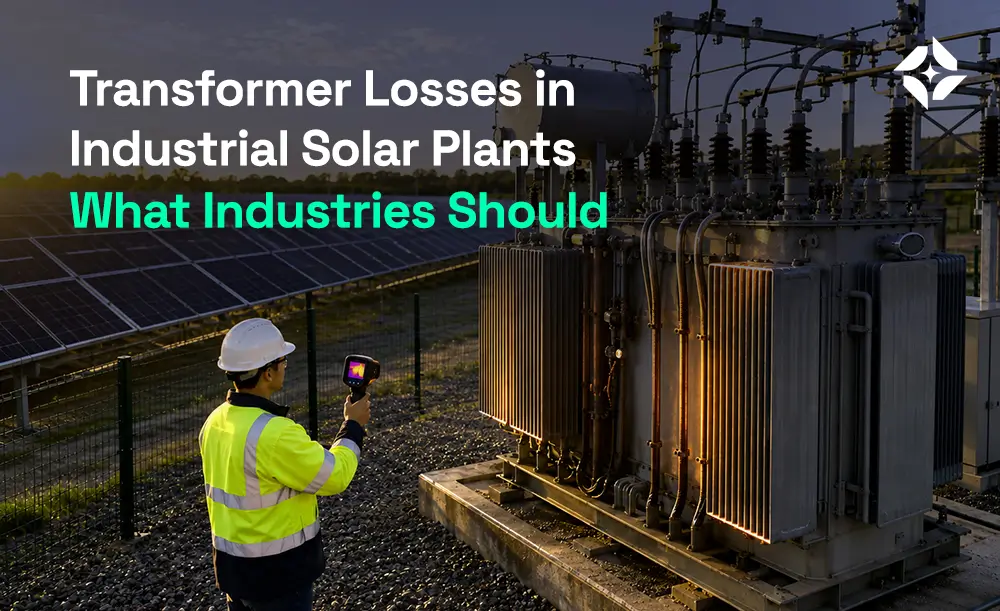
A transformer is one of the last major electrical components that power passes through before solar energy reaches a factory load or the grid. Because it does not generate power itself, its role is easy to overlook when a project is being evaluated.
That can be a mistake.
Every transformer introduces some energy loss. The important question is whether those losses are appropriate for the way the plant actually operates. In an industrial solar project, transformer capacity, loading pattern, inverter output and operating temperature can all influence how much useful energy finally reaches the consumer.
Where the Transformer Fits in an Industrial Solar Plant
Solar Modules → DC Cables → Inverter → AC Panel → Transformer → HT Panel / Factory Load / Grid
Solar modules generate DC electricity. The inverter converts it into AC, and the transformer then changes the voltage to suit the plant’s internal electrical network or grid connection.
By this point, some energy has already been lost through the inverter and electrical conductors. Transformer loss becomes another part of the total system loss.
This is why transformer selection should be coordinated with the wider electrical design, including AC and DC cable losses, rather than treated as a separate procurement item.
Where Does a Solar Transformer Lose Energy?
Two losses matter most in day-to-day solar plant operation: no-load loss and load loss.
No-Load Loss: What Happens When Generation Is Low?
No-load loss is mainly associated with the transformer core. It exists whenever the transformer is energized, even when only a small amount of power is passing through it.
This matters in solar because output is naturally low in the morning and late afternoon. The transformer may remain active during those periods while handling only a fraction of its rated capacity.
So, a transformer that looks efficient at full load may not necessarily be the best fit for a plant that spends many hours operating at partial load.
Load Loss: Why Higher Current Creates More Loss
Load loss is mainly related to current flowing through the transformer windings.
As current rises, resistive heating in the windings also increases. This makes load loss more important during stronger generation hours, when the inverter is delivering higher output.
The objective is not to eliminate one type of loss in favour of the other. Good design looks at how both behave across the plant’s actual operating range.
Why Solar Generation Patterns Matter for Transformer Losses
A solar transformer does not operate at one fixed load throughout the day.
Output may rise gradually after sunrise, reach its strongest period around midday and then fall again. Cloud cover, seasonal irradiation, plant downtime and module temperature change the curve further.
That is why rated efficiency alone is not enough when comparing transformers.
A more useful question is:
How efficiently will this transformer operate across the loading pattern the plant experiences over an entire year?
That operating profile should influence the final equipment selection.
How Transformer Sizing Changes Energy Loss
Transformer sizing is often treated as a capacity question, but it is also an efficiency question.
What Happens When a Transformer Is Too Large?
An oversized transformer may spend much of the day lightly loaded.
Its no-load loss is still present during those hours, while relatively little power is being transferred. There is also additional capital tied up in unused capacity.
Some design margin may be justified, but adding capacity without considering the actual generation profile can work against project economics.
What Happens When a Transformer Is Too Small?
An undersized transformer creates the opposite concern.
During peak generation, it may operate close to its limit. Higher current can increase winding losses and temperature while leaving less operating margin.
Transformer capacity should therefore be coordinated with plant size, inverter arrangement and expected output. The same system-level approach applies to inverter sizing.
Can Inverter Harmonics Add to Transformer Losses?
Solar inverters use power electronics to produce AC output. Depending on the system design and operating conditions, harmonic currents can create additional heating in the transformer.
This does not mean harmonics will always become a major source of loss. It does mean the transformer should be suitable for the actual inverter application rather than selected only because its voltage and kVA rating appear correct.
Thermal conditions matter as well. Higher winding temperature increases resistance, so ventilation, loading and connection quality should not be ignored.
What Do Transformer Losses Mean for Plant Performance?
The practical impact is simple: energy lost inside the transformer does not reach the factory load or export point.
The loss may not be large enough to cause a visible fault, but recurring losses can gradually widen the difference between expected and delivered generation.
For a plant owner, that can influence:
- usable energy,
- overall plant efficiency,
- long-term savings,
- project returns.
This is why transformer losses should already be included in performance modelling rather than investigated only after the plant starts underperforming.
How Can Transformer Losses Be Kept Under Control?
Most of the important decisions happen during engineering.
The EPC should compare actual no-load and load-loss data, match transformer capacity to realistic plant loading and avoid unnecessary oversizing. Voltage ratio and inverter compatibility also need to suit the wider electrical architecture.
Once the plant is operational, cooling, terminal condition, loading and abnormal heating should be checked during routine O&M.
The goal is not a zero-loss transformer. That is unrealistic. The goal is to avoid unnecessary loss created by poor sizing, weak equipment selection or unsuitable operating conditions.
What Should Your EPC Check Before Choosing the Transformer?
Before approving a transformer, the project team should be able to explain more than its capacity and price.
| Check | Why It Matters |
|---|---|
| Rated capacity | Should match realistic plant loading |
| No-load loss | Important during lower-output periods |
| Load loss | Becomes more relevant at high generation |
| Voltage ratio | Must suit the electrical design |
| Inverter compatibility | Helps avoid application mismatch |
| Cooling arrangement | Supports stable operating temperature |
| Guaranteed loss data | Helps estimate annual transformer energy losses |
For transformer loss measurement, IEC 60076-19-1:2023 provides procedures for evaluating uncertainty in the measurement of no-load and load losses during routine transformer tests.
It is also worth asking whether the selected transformer’s actual loss data has been included in the generation estimate.
A broader solar project risk audit can help identify connected electrical issues before the EPC design is locked.
Conclusion
Transformer losses in industrial solar plants should be managed through design, not accepted blindly as a fixed cost of generation.
The right transformer is not necessarily the largest or the cheapest option. It is the one that fits the plant’s loading pattern, inverter configuration, voltage requirement and long-term operating conditions. For an industrial solar system, that makes transformer selection an energy-performance decision as much as an equipment decision.
Raynex Power Solution helps industrial and commercial businesses evaluate solar system design, electrical losses and plant performance to support more efficient and reliable solar projects.
FAQs
What is no-load loss in a solar transformer?
It is the energy mainly associated with the transformer core while the unit remains energized, even when very little power is being transferred.
Why does transformer load loss increase with generation?
Higher solar output generally means more current passes through the transformer windings. Greater current increases resistive heating and therefore load-related loss.
Can an oversized transformer reduce project efficiency?
It can if the transformer spends long periods lightly loaded. In that situation, fixed no-load loss may become more significant relative to the power being transferred.
Does transformer temperature affect energy loss?
Yes. As winding temperature rises, conductor resistance also increases. Excessive loading, poor ventilation or faulty connections can therefore increase losses.
Should transformer loss data be included in solar generation estimates?
Yes. Using the actual transformer’s loss characteristics gives a more realistic view of the energy expected at the factory or grid connection point.