
Solar panels turn sunlight into electricity that homes, businesses, and industrial properties can use. As electricity costs rise, more property owners are looking at solar as a way to reduce their dependence on grid power. But how do solar panels work, and what actually happens after sunlight reaches the panel?
The process starts inside photovoltaic cells, where sunlight is converted into direct current, or DC electricity. A solar inverter then converts DC into alternating current, or AC electricity, which can power the property. Depending on the system design, surplus electricity may be exported to the grid or stored in a battery.
This guide explains how solar panels generate electricity, step by step, along with the main components and factors that affect performance.
What is a Solar Panel?
A solar panel is made up of many small units called photovoltaic cells, also known as PV cells. These cells usually contain semiconductor material such as silicon.
When sunlight reaches the cells, they absorb light energy and generate an electrical current through the photovoltaic effect. Several cells work together inside one panel, while multiple panels can be connected to create a larger solar array.
How Do Solar Panels Work? Step-by-Step Process
Solar panels follow a clear process from capturing sunlight to supplying usable electricity.
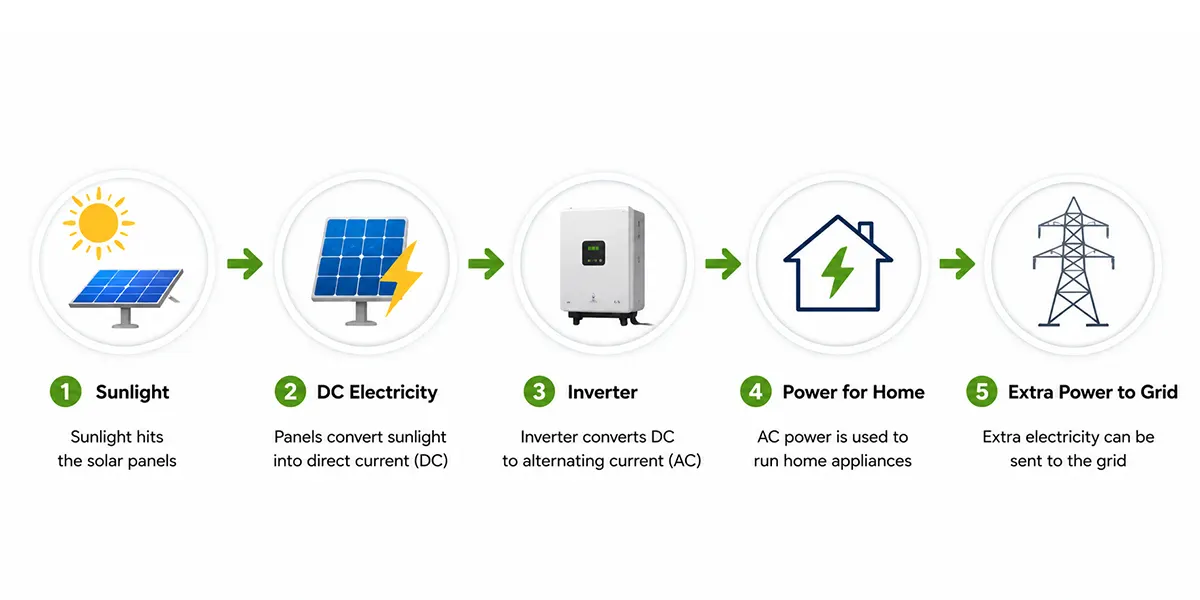
Step 1: Sunlight Hits Photovoltaic Cells
The solar panel process begins when sunlight reaches the PV cells.
The semiconductor material inside each cell absorbs part of the light energy. This starts the electrical process that allows the panel to generate power.
Step 2: Photovoltaic Cells Generate DC Electricity
Sunlight contains small packets of energy called photons.
When photons reach the semiconductor material inside a solar cell, they transfer energy to electrons. This causes electrical charges to move through the cell.
Conductive contacts collect the resulting electrical current as direct current, or DC electricity.
Step 3: Solar Inverter Converts DC to AC Electricity
Solar panels produce DC electricity, but most homes, offices, commercial buildings, and factories use alternating current, or AC electricity.
The solar inverter converts DC electricity from the panels into AC electricity so it can be used by the property’s electrical system.
Step 4: AC Electricity Powers Your Property
Once converted, AC electricity flows into the property’s electrical distribution system.
In a home, this power may run lights, fans, appliances, and electronics. In a business or industrial facility, it may support office equipment, cooling systems, motors, machinery, and other electrical loads.
Step 5: Excess Solar Electricity Goes to the Grid or Battery
A solar system may generate more or less electricity than the property needs at a particular time.
If generation is higher than demand, surplus electricity may be exported to the grid or stored in a solar battery, depending on the system configuration.
If generation is lower than demand, a grid-connected property can draw the remaining electricity from the grid.
The way electricity is managed also varies across different residential solar systems, including on-grid, off-grid, and hybrid setups.
Photovoltaic Cell Working Principle: How Solar Cells Convert Sunlight Into Electricity
The photovoltaic cell working principle explains what happens inside the solar cell.
When photons reach the semiconductor material, they transfer energy to electrons. The internal electric field of the cell helps direct these electrical charges, while conductive contacts collect the resulting current.
Metal contacts collect the resulting current and allow it to leave the cell as DC electricity.
This photovoltaic effect is the basic reason solar panels can convert sunlight into electrical power without burning fuel or using moving mechanical parts inside the panel.
Key Components of a Solar Energy System
A solar energy system uses several key components to generate, convert, distribute, store, and measure electricity.
- Solar Panels: Capture sunlight and generate direct current (DC) electricity through photovoltaic cells.
- Solar Inverter: Converts the DC electricity produced by the panels into alternating current (AC) electricity that the property can use.
- Electrical Distribution and Protection Equipment: Carries solar electricity safely to the property’s electrical system and includes equipment used for isolation and electrical protection.
- Solar Battery (Optional): Stores surplus solar electricity for later use, depending on the system design and energy requirements.
- Bidirectional / Net Meter: Measures electricity imported from the grid and surplus solar electricity exported to it in applicable grid-connected systems.
Not every solar system requires a battery. The exact configuration depends on whether the system is grid-connected, off-grid, or designed with battery storage and backup capability.
Do Solar Panels Work on Cloudy Days?
Yes. Solar panels do work on cloudy days or in the rain because solar radiation can still reach the photovoltaic cells.
However, electricity generation is usually lower than on a clear day. Actual output depends on cloud cover, available solar irradiance, panel technology, shading, orientation, and other site conditions.
Do Solar Panels Work at Night?
No. Solar panels do not generate electricity at night because sunlight is unavailable. A grid-connected property can draw electricity from the grid, while a system with suitable battery storage may use energy stored earlier in the day.
Factors That Affect Solar Panel Performance
Panel Orientation and Tilt
Panel orientation and tilt affect how much solar radiation reaches the module surface. The most suitable position depends on the installation location, roof or site layout, surrounding obstacles, and system design. A properly designed mounting structure helps keep the panels at the planned angle and orientation.
Shading and Soiling
Trees, nearby buildings, water tanks, poles, and other objects can cast shadows on solar panels and reduce generation. Dust, leaves, bird droppings, and other deposits can also block sunlight from reaching the cells. Proper placement and appropriate cleaning can help reduce these losses.
Temperature
Hot weather does not always mean higher solar output. Solar panels need sunlight, but electrical performance can decrease as cell temperature rises. Solar modules are commonly rated under Standard Test Conditions at a cell temperature of 25°C, while actual operating temperatures may be higher.
Panel Degradation
Solar panels gradually lose a small amount of their maximum output over time. Quality modules are designed to continue generating electricity for decades, although performance depends on module quality, operating conditions, installation, and maintenance.
Benefits of Installing Solar Panels
Key solar panel benefits include reducing dependence on grid electricity and potentially lowering long-term energy costs. Solar PV also generates electricity without direct fuel combustion during normal operation.
These renewable energy benefits make solar useful for homes and businesses looking to improve energy management and reduce their reliance on conventional electricity sources.
Conclusion
So, how do solar panels work? Photovoltaic cells absorb sunlight and generate DC electricity. The solar inverter converts that electricity into AC power, and the property uses it for its electrical needs. Surplus electricity may then be exported to the grid or stored in a battery.
A well-designed solar system depends on more than the panels alone. Site conditions, shading, orientation, inverter selection, system size, and electrical design all influence real-world performance.
If you are considering solar for your home, business, or industrial property, Raynex Power Solution can assess your electricity requirements, site conditions, and project goals to recommend a suitable solar solution.
Contact Raynex Power Solution to discuss a solar system suited to your property’s energy requirements..
FAQs
How Much Electricity Does a Solar Panel Produce?
Solar panel output varies by module size, cell technology, efficiency, and application. Modern modules are available across a wide range of power ratings, including many models above 500 W. Actual electricity generation also depends on sunlight, shading, orientation, temperature, and site conditions.
How long do solar panels typically last?
Solar panels are designed for decades of operation. Their maximum output gradually declines over time, but quality modules can continue producing electricity for 25 years or longer depending on product quality, installation, environment, and maintenance.
Do Solar Panels Produce AC or DC Electricity?
Solar panels produce DC electricity. A solar inverter converts that DC power into AC electricity that most homes and businesses can use.
Does rain damage solar panels?
Normal rainfall does not usually harm properly installed solar panels and may remove some loose surface dust. However, bird droppings, heavy soiling, and other deposits may still require appropriate cleaning.
Can Solar Panels Work During a Power Cut?
A standard grid-connected solar system may shut down during a power outage for safety. Backup power usually requires compatible inverter equipment, suitable battery storage, and the correct electrical configuration.