
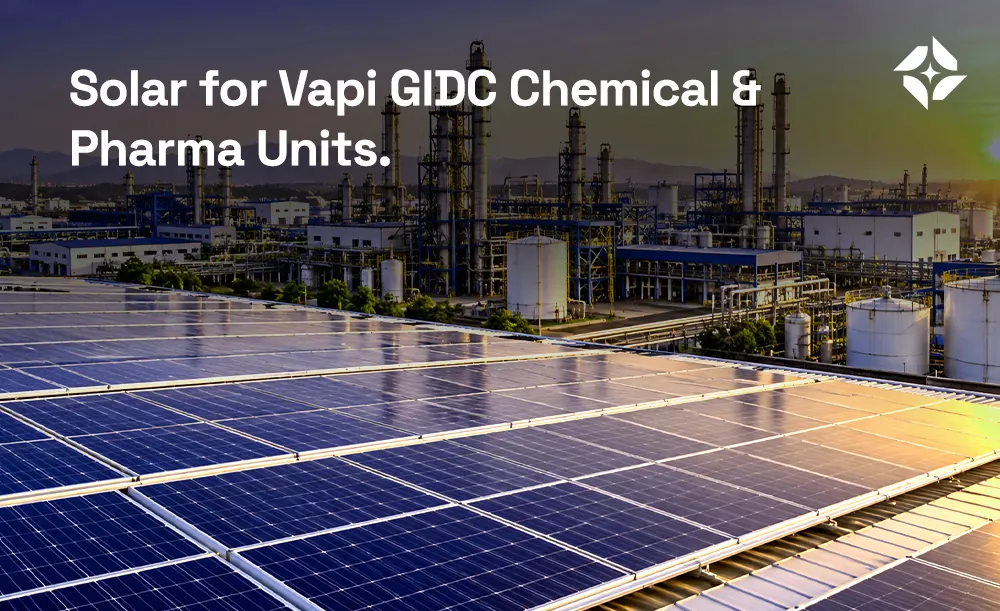
Vapi’s chemical and pharma units have almost the perfect load for solar, making industrial solar Vapi a practical solution for reducing electricity costs. Chillers, dryers, HVAC and utilities run hardest during the daytime, right when panels produce the most power. But a Vapi GIDC roof is not an ordinary roof. Salt air, acid fumes, solvent stores and cleanrooms can turn a standard rooftop kit into a rusted, unsafe plant within a few years.
This guide covers what industrial solar in Vapi needs to work safely for 25 years. We are Raynex Power Solution, a solar EPC company in Gujarat with a branch in Vapi, and these are the points we check on every chemical and pharma site.
Why Industrial Solar in Vapi Makes Sense for Chemical and Pharma Units
Businesses looking for a solar company in Vapi can explore industrial solar solutions suited to their facility. Its GIDC phases are mostly dye and pigment units (about 46%), then chemical units (about 36%), then API and finished pharma units (about 18%). Most of these units pay HT tariffs and run heavy loads through the day. Solar replaces the units you buy at the highest cost, during the hours you use the most.
Pharma units fit especially well. HVAC alone can make up roughly 40% of a pharma plant’s bill, and it runs hardest in the hot daytime hours. There is also an export reason. Many Vapi units sell to buyers in Europe and the US who now ask about renewable energy use, and a captive solar plant is one of the simplest ways to show progress.
What Makes Vapi GIDC Different From Other Solar Sites
A solar plant in Ahmedabad and one in Vapi may look the same from the ground. On the roof, Vapi needs extra care in three areas.
Salt Air Plus Chemical Fumes
Vapi sits close to the Arabian Sea coast, so the air carries salt. Add acid vapour from scrubbers, vents and storage tanks, and metal on the roof corrodes much faster than at an inland site. Engineers rate this using corrosion categories from ISO 9223, from C1 (very low) to CX (extreme). Coastal industrial sites like Vapi often fall in the C4 or C5 range. Coating systems are then chosen to match, using guidance like ISO 12944.
In practice, this means:
- Heavier galvanising on steel structures, with the coating thickness stated in microns, or anodised aluminium in the worst spots. [Add Raynex standard spec for Vapi, in microns.]
- Stainless steel nuts and bolts, since cheap zinc-plated fasteners often rust first.
- Modules tested for harsh air, such as salt-mist testing under IEC 61701 and ammonia testing under IEC 62716, plus PID resistance under IEC 62804.
A structure that rusts out in year 6 means taking down and refitting the whole plant. The extra cost of the right spec on day one is small compared to that.
Solvent Areas and Hazardous Zones
Many chemical and pharma units handle flammable solvents. Areas around solvent storage, reactors and transfer points are often marked as hazardous zones under IS/IEC 60079-10-1, where any spark could cause a fire. Standard solar inverters, combiner boxes and DC connectors are not made for these zones. The safest rule is to keep all solar electrical gear outside classified areas, and route DC cables around them.
Before finalising a contractor, review this checklist for choosing a solar EPCcompany for industry. If an EPC team does not ask for it, that is a warning sign.
Fire Safety and Insurance
A rooftop plant adds DC wiring to your roof, and DC can stay live even when the grid is off. Your fire team needs a clear way to isolate the plant fast. A good layout includes DC isolators that are easy to reach, fire access lanes between panel blocks, and clear signs at roof access points. Tell your insurer before installation so the plant is covered under your policy and meets their conditions.
Solar for Pharma Units: Cleanrooms, HVAC and GMP
Pharma roofs need a different plan from chemical roofs. The main risks are leaks, dust and disturbance above controlled areas. Avoid drilling above cleanrooms. A single leak above a cleanroom can stop production and trigger a deviation report. On RCC roofs, use non-penetrating or ballasted mounts where the structure allows. In one 509 kWp pharma project in Gujarat, the team took extra care not to drill through the slab, to prevent seepage.
Leave space around HVAC. Rooftop AHUs, ducts and exhaust fans need access for service. Panels should not block airflow or create hot spots near intake vents.
Plan the work around production. Use your permit-to-work system, keep material lifting away from sensitive areas, and plan any shutdown for tie-in with your QA team.
Keep the paperwork clean. Auditors may ask about any change to your site. Keep the layout drawings, structural approval, test reports and handover documents in one file.
Solar for Chemical Units: Stacks, Scrubbers and 24×7 Loads
Chemical units face a different set of rooftop problems.
Stacks and scrubbers cast shade and drop residue. Tall stacks can shade parts of the roof, especially in winter. Their emissions can also leave deposits on nearby panels, so leave a buffer zone around them.
Place inverters away from vents. Inverters breathe air through their cooling systems. Keep them on the side of the roof away from acid vents, ideally upwind of the main wind direction.
Size for the daytime share of load. Many chemical units run 24×7, but solar only covers daytime use. Night loads like ETP pumps, lighting and instruments will still need grid supply.
Dye and pigment units often have large, open roofs and heavy daytime drying and grinding loads. These are some of the best solar fits in Vapi.
Standard Rooftop vs Vapi GIDC Solar Spec
Use this table to compare quotes. If a vendor offers the left column for a Vapi chemical or pharma roof, ask why.
| Item | Standard rooftop spec | Vapi GIDC spec |
|---|---|---|
| Mounting structure | Hot-dip galvanised steel | Heavier galvanising matched to C4/C5 category, or anodised aluminium near vents |
| Nuts and bolts | Zinc-plated | Stainless steel |
| Modules | ALMM-listed | ALMM-listed, plus salt-mist, ammonia and PID test reports |
| Inverter rating | IP65 | IP65 or IP66, placed away from vents and outside hazardous zones |
| Junction and combiner boxes | IP65 | IP66, with breather to stop moisture build-up |
| DC cable routing | Standard trays | Covered trays, kept clear of acid drains and hazardous zones |
| Cleaning | Plain water, fixed schedule | Low-TDS water, more frequent near stacks |
| O&M checks | Yearly thermal scan | Thermal scan plus regular corrosion and torque checks |
Approvals for Industrial Solar in Vapi
Most Vapi industrial units are served by DGVCL. The main approval steps are:
- GEDA registration: Your project is registered with an approved AC plant size.
- DGVCL feasibility and agreement: DGVCL checks transformer and feeder capacity, then signs an interconnection agreement. For HT plants above 6 kW and up to 1,000 kW, system strengthening charges may apply.
- Electrical inspector approval: HT plants usually need drawing approval and inspection by the Chief Electrical Inspector before start-up.
- Meter installation: DGVCL fits the solar and net meters, and the plant starts operating.
Stay within the approved size. In a 2026 case, GERC upheld a penalty of over ₹4.3 lakh against an MSME that ran about 60 kW of solar when only 50 kW AC was approved.
Also check your own site conditions. Your GIDC plot terms, pollution board consent conditions and factory insurance may need an update or a simple note to the right office. Your EPC company should help you check this early, not after the plant is built.
How Big Should Your Vapi Plant Be?
Three things decide the right size: your daytime load, your roof, and the rules.
Rules: Gujarat allows net metering for rooftop plants from 1 kW to 1 MW. For captive consumers, there is no size limit up to the sanctioned load. Above 1 MW, other routes like captive or open access apply.
Daytime load: HT and EHV consumers with captive solar can set off energy only between 7 am and 6 pm on the same day. So size the plant to your daytime use, not your 24-hour average.
Roof: Plan for about 100 sq ft of shadow-free roof per kW, then subtract space for stacks, vents, skylights and walkways. A 500 kW plant needs roughly 50,000 sq ft of usable roof.
The plant should match the smallest of these three limits. A bigger plant that you cannot use in the daytime window rarely pays back as well.
CAPEX, RESCO or Group Captive: Which Fits Your Unit?
There are three main ways to pay for industrial solar in Vapi.
CAPEX: You buy and own the plant. You keep all the savings and can claim tax benefits like accelerated depreciation (check with your CA). This usually gives the best long-term return for profitable units.
RESCO: A developer builds and owns the plant on your roof, and you buy the units at a fixed rate for 15 to 25 years. You pay nothing upfront, but your savings are lower.
Group captive: Several units share one larger plant, often a ground mount solar plant on land elsewhere. This suits units with small roofs and large loads. It involves more paperwork, since the units need to hold equity in the plant company.
How Raynex Power Solution Works With Vapi Units
Raynex Power Solution has a branch in Vapi, so our team can reach GIDC Phase 1 to Phase 4 and Sarigam sites quickly for surveys and service.
On every chemical and pharma site, we start with your hazardous area drawing, roof condition and 12 months of bills. Then we build a layout that keeps solar gear out of risk zones, uses coastal-grade parts, and matches your daytime load.
We also handle GEDA, DGVCL and electrical inspector approvals, and hand over full documents for your audit file. Learn more about our industrial solar work.
Conclusion: Build for Vapi, Not for an Average Roof
Industrial solar in Vapi can cut your daytime energy costs and help you meet buyer demands for cleaner energy. But only if the plant is built for salt, fumes, solvents and cleanrooms from day one.
Compare every quote against the spec table above. Ask for your hazardous area drawing to be part of the layout. And keep your plant size within your daytime load and approved limits.
Planning solar for your unit in Vapi GIDC or Sarigam? Share your last 12 months of DGVCL bills with the Raynex Power Solution Vapi team for a free site, safety and load survey. Call +91 90332 32512, or get a quick figure from our solar estimate tool.
Frequently Asked Questions
Is rooftop solar safe on a chemical plant in Vapi?
Yes, when the layout keeps inverters, combiner boxes and DC cables outside hazardous zones. Ask your EPC company to work from your hazardous area drawing and include fire isolation points in the design.
Can solar panels go above a pharma cleanroom?
Yes, but avoid drilling into the roof above controlled areas. Use non-penetrating mounts on RCC roofs where the structure allows, and plan all work with your QA team.
Will salt air damage solar panels in Vapi?
It can damage cheap structures and fasteners within a few years. Choose heavier galvanising or aluminium, stainless steel bolts, and modules with salt-mist and ammonia test reports.
How much solar can a Vapi HT unit install under net metering?
Gujarat allows rooftop net metering from 1 kW up to 1 MW. Captive consumers can install up to their sanctioned load, subject to DGVCL’s technical check.
What happens if I install more solar than approved?
DGVCL can treat it as unauthorised use and charge a penalty. Always keep the installed AC size within your GEDA approval and interconnection agreement.
Do chemical and pharma units in Vapi get a solar subsidy?
No. Central rooftop subsidies cover homes and housing societies, not industrial units. Factories can benefit from tax savings like accelerated depreciation instead.