
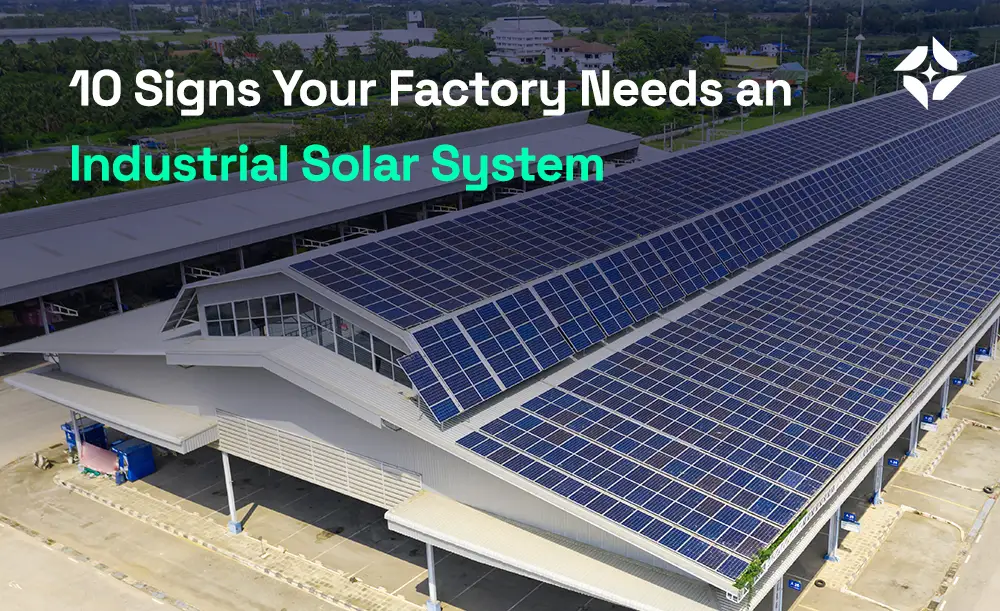
Electricity is an important resource for factories to power machinery, production processes, lighting, cooling, and daily functions. When the cost of electricity becomes high for businesses, or when electricity consumption increases, a better energy solution should be considered. An industrial solar system can help factories lessen their reliance on grid electricity and control their overall energy use in the long-term.
But how do you know if your factory requires solar energy? In this blog, we will share 10 essential signs that show whether your factory needs an industrial solar system.
10 Signs Your Factory Needs an Industrial Solar System
Recognizing the need for a change is the first step toward saving money. There are clear indicators in your daily operations and monthly statements that suggest it is time to move away from old power methods. When you notice these signs, it usually means you are ready for a factory solar setup that works for you.
Sign #1. Your Electricity Bills Are Consistently High
The most obvious sign that your factory needs an industrial solar system is the size of your monthly utility bill. If a large portion of your income is going straight to the power company, you are losing money that could be used to buy new equipment or hire more staff. Most factories use high-voltage machinery that drains power constantly.
Solar panels help by producing electricity right where you need it. By using the sun’s energy, you can drastically cut down the amount of power you buy from the city. Over time, these savings add up to thousands of dollars, making your business much more profitable.
Sign #2. Your Factory Operates During Daytime Hours
Solar panels are most productive when the sun is high in the sky. If your main production shifts happen between 8:00 AM and 6:00 PM, you are in the perfect position. This is when your factory uses the most energy, and it is exactly when an industrial solar system is working at its peak.
By matching your peak usage hours with peak sunlight hours, you avoid using expensive grid power during the day. This direct consumption of solar energy is the most efficient way to use the system. It ensures that every ray of sunlight hitting your roof is turned into useful work for your assembly lines.
Sign #3. Electricity Costs Keep Increasing
Have you noticed that your power rates go up every year? Utility companies often raise their prices to cover their own costs or fix old power lines. These price hikes are hard to predict and even harder to manage in a budget. If you are tired of these surprises, it is a sign that your factory needs an industrial solar system to gain some control.
Solar power provides a fixed cost for energy. Once the panels are installed, the sunlight is free. You no longer have to worry about the power company changing their rates next month. This stability allows you to plan your business finances with much more confidence.
Sign #4. Your Factory Has a Large, Suitable Roof
Take a look at the top of your building. If you have a vast, flat roof that is just sitting there in the sun, you are wasting valuable space. To find out is you factory suitable for solar, you should check if the roof is strong and clear of shade. A large roof area allows you to install enough panels to cover a huge chunk of your energy needs.
Using your existing roof means you do not have to buy extra land for your power plant. It is a smart way to use the assets you already own. If your roof is in good condition and gets plenty of sun, it is practically shouting for a solar installation.
Sign #5. Your Factory Has Open Land Available
Not every factory has a perfect roof, but many have extra land nearby. If you have empty ground on your property that isn’t being used for parking or storage, it is a great spot for solar panels. Ground-mounted systems can sometimes be even better than roof systems because they can be angled perfectly toward the sun.
Having this extra space is a clear sign that your factory needs an industrial solar system. You have the room to expand your solar capacity as your factory grows. It turns unused dirt into a power-generating machine that fuels your success.
Sign #6. Your Business Uses a Lot of Electricity
Factories that run heavy compressors, melting furnaces, or large-scale HVAC systems are high-energy users. If your meter is spinning fast every single hour, the return on investment for solar will be very quick. To determine the right solar system size for factories, you need to look at your peak load and total annual units.
High users benefit the most from solar because every kilowatt generated saves them from a higher pricing bracket. If your energy demand is massive, solar is the most effective tool you have to lower your overhead costs quickly.
Sign #7. You Want to Reduce Dependence on Grid Electricity
Factories that require power from the grid can consider solar power as an option to decrease the quantity of electricity they purchase from the grid.
An on-grid industrial solar system produces electricity during the day and feeds it directly into the electricity system of the factory. In case the solar production is lower than the energy consumption of the factory, electricity can still be supplied from the grid, according to the applicable system conditions and regulations.
Solar doesn’t mean that the factory will totally disconnect from the electricity grid. It can rather decrease its dependence on the electricity power supply from the electricity grid by generating a part of its electricity needs in-house.
Sign #8. You Want More Predictable Long-Term Energy Costs
Budgeting for a factory is hard when energy prices are unstable. If you want to know exactly what your power will cost ten years from now, solar is the answer. Solar systems are designed to last for 25 to 30 years with very little maintenance.
This long-term reliability means you can calculate your energy costs for the next two decades today. If your goal is to have a stable and predictable business model, moving to solar is the best way to lock in your energy prices for the long haul.
Sign #9. Your Factory Has a Long-Term Operating Plan
Solar is an investment in the future. If you plan to stay in your current location for the next 10 or 20 years, it makes perfect sense to install panels. The money you save over those years will far exceed the initial cost of the setup.
If you see your factory growing and thriving in the same spot for a long time. It protects your future profits and ensures that your facility remains modern and efficient as the years go by.
Sign #10. You Want to Reduce Your Factory’s Carbon Footprint
Today, many customers and partners care about the environment. If your factory produces a lot of smoke or uses massive amounts of coal-based power, your “carbon footprint” is quite large. Switching to clean energy is a great way to show that your business cares about the planet.
Reducing your carbon footprint can also help you get better contracts with international companies that require green standards. If you want to be known as a responsible and modern manufacturer, solar is the way to go. It’s a win for your wallet and a win for the earth.
Looking for Reliable Industrial Solar Services in Surat?
Choosing a trusted solar EPC company is important for accurate installation and design, and also for effective maintenance of a solar project.
Raynex Power Solution is located in Surat and offers all solar EPC services, thus covering all steps of a solar project from site survey, design and equipment sourcing to installation, start-up and further operation and maintenance of the system. The company mainly focuses on solar solutions for rooftop and ground-mounted solar systems.
Raynex Power Solution is among the leading solar companies in Surat, which has long experience in the given market and is thus capable of offering the best solar solutions for companies, helping them minimize their energy costs and maximize energy efficiency.
FAQs
How long does it take for a factory solar system to pay for itself?
Generally, most industrial systems pay for themselves in 3 to 5 years through energy savings. After that, the electricity produced is essentially free for the remaining life of the system.
Will the solar panels work during rainy or cloudy days?
Yes, panels still produce electricity on cloudy days, though at a lower rate. On very rainy days, production is low, but the grid will automatically supply any extra power you need.
Does my roof need to be replaced before installing solar?
If your roof is old or damaged, it is best to repair or replace it before installation. Solar panels last for 25 years, so you want a strong base that won’t need work shortly after the panels are up.
Can I run my factory entirely on solar power?
It is possible, but most factories use a mix of solar and grid power. This ensures you have electricity even at night or during very high demand periods without needing a massive battery bank.
Is there maintenance involved with an industrial solar system?
Solar systems require very little maintenance. You mainly need to keep the panels clean from dust and bird droppings to ensure they capture as much sunlight as possible.