
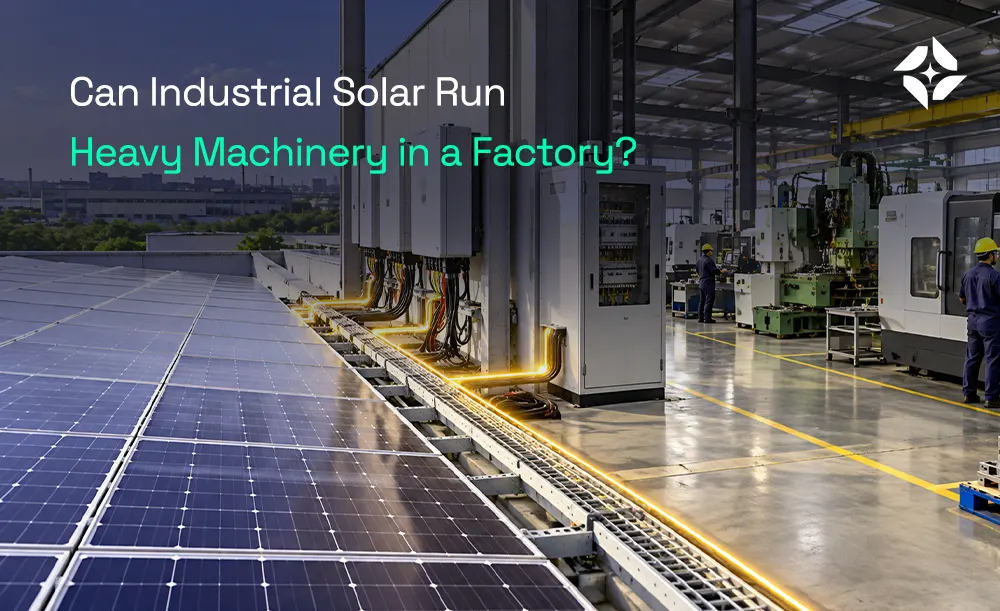
Industrial solar Run heavy machinery can help factories meet part of their daily electricity demand while reducing their dependence on grid electricity. The amount of energy supplied depends on the factory’s machine load, working hours, available roof area, and solar system design. Equipment such as industrial motors, air compressors, pumps, conveyors, and CNC machines may operate alongside a suitable solar installation. However, each factory needs a technical assessment before selecting the system capacity.
For factories in Surat, Vapi, Ahmedabad, and other industrial areas of Gujarat, solar planning should begin with actual electricity consumption rather than the total rated capacity of every machine. Engineers must also assess motor startup requirements, electrical protection, and the factory’s operating schedule. These checks help determine how much solar energy can be used during production hours. A properly designed system can help a business control electricity costs while maintaining its production requirements.
How Does Industrial Solar Work in a Factory?
An industrial solar installation uses photovoltaic (PV) modules to convert sunlight into electricity. The modules connect to inverters, which convert the generated direct current (DC) into alternating current (AC) for compatible electrical systems. In a grid-connected factory, solar electricity can supply the facility’s electrical loads while the grid provides electricity when solar generation is insufficient. The exact arrangement depends on the electrical design, applicable regulations, and the factory’s energy requirements.
Solar generation changes throughout the day. It generally increases after sunrise, reaches a higher level during suitable daylight conditions, and decreases toward sunset. Clouds, dust, module temperature, shading, and equipment condition can affect generation. Factory demand also changes as machines start, stop, and move between production stages.
For example, a factory may run its compressors, pumps, and production machines during daytime shifts. If the solar installation generates electricity at the same time, the factory can use that energy directly, subject to its electrical configuration. If demand exceeds solar generation, the grid can supply the shortfall in a grid-connected arrangement. This is why matching solar generation with the factory’s operating schedule is an important part of system design.
Which Types of Heavy Machinery Can Solar Support?
Solar electricity can supply many types of industrial equipment through a correctly designed electrical system. However, the suitability of a particular machine depends on its energy consumption, startup behaviour, voltage requirements, and operating conditions. The following examples can help factory owners identify which loads should be assessed during a site survey.
1. Industrial Motors, Pumps, and Compressors
Industrial motors are used in manufacturing plants, processing units, workshops, and material-handling systems. Pumps circulate water or other fluids, while compressors supply compressed air to tools and production equipment. These loads may account for a considerable share of a factory’s electricity consumption, depending on the process.
Solar can offset the electricity used by these machines when their operating hours overlap with solar generation. However, motor startup can require more current than normal running operation. Engineers should review the motor nameplate, starting method, load characteristics, and any variable frequency drive (VFD) before confirming the system design.
2. CNC Machines and Production Equipment
CNC machines, cutting equipment, drilling machines, and automated production lines may have different electrical requirements. Some machines include motors, control systems, cooling units, and auxiliary equipment that operate at different times. Their total demand should be assessed as a complete load rather than by considering only the main motor.
A factory with several CNC machines may benefit from a solar installation that offsets daytime consumption. The design should account for peak demand, equipment sensitivity, and the quality of the electrical supply required by the machines. Where the production process requires continuous operation, the factory must also plan for periods when solar generation falls.
3. Conveyors, Hydraulic Presses, and Material-Handling Systems
Conveyors, hydraulic presses, lifting equipment, and material-handling machines can have changing load profiles. Some operate at a fairly steady rate, while others draw higher current during starting or during demanding production stages. These variations can affect inverter selection and the way the solar system connects to the factory distribution network.
A load study can identify the equipment that consumes the most electricity during daylight hours. Engineers can then assess the appropriate solar capacity and electrical arrangement. The objective is to match the installation to the factory’s real operating conditions rather than relying on a broad estimate.
4. Electric Furnaces and Industrial Heating Equipment
Electric furnaces, ovens, and other heating equipment may consume large amounts of electricity. Their suitability for solar depends on rated capacity, heating cycles, operating temperatures, and total energy demand. Equipment with high continuous demand may require a different assessment from a motor that runs intermittently.
A solar installation can offset part of the electricity used by heating processes when the generation profile matches demand. However, a factory should not assume that a rooftop system will independently meet the full load of a high-temperature process. A detailed electrical and energy assessment is required before making that decision.
What Determines If Solar Can Run Heavy Machinery?
The presence of solar panels alone does not determine if a factory can operate its machinery as required. The system must match the electrical characteristics of the machines and the factory’s expected energy use. The following factors should be assessed before installation.
1. Machine Load and Actual Electricity Consumption
The rated capacity of a machine shows its specified electrical or mechanical rating, depending on the equipment and nameplate. It does not necessarily indicate how much electricity the machine uses throughout a full shift. Actual consumption depends on the load, operating time, efficiency, and production process.
For example, two machines with similar rated capacities may have different daily energy consumption because they run for different durations or operate under different loads. Reviewing electricity bills, meter readings, and interval consumption data helps establish the factory’s demand profile. This information provides a more useful starting point for estimating the required solar capacity.
2. Motor Starting Current and Peak Demand
Some industrial motors draw a high current during startup. The size and duration of this demand depend on the motor, starting method, mechanical load, and electrical arrangement. If these conditions are not assessed, the selected inverter or electrical equipment may not be suitable for the intended application.
Engineers should review direct-on-line starting, star-delta starting, soft starters, and VFDs where applicable. They should also assess how several machines behave when starting at the same time. This helps determine the required ratings and operating limits of the connected equipment.
3. Three-Phase Supply and Electrical Protection
Many factories use three-phase electrical systems for motors and industrial machinery. The solar installation must be compatible with the site’s supply arrangement, distribution boards, voltage requirements, and applicable grid-connection rules. Electrical protection and isolation equipment must also be selected for the installation.
The design should include suitable earthing, overcurrent protection, surge protection, cable sizing, and isolation arrangements as required by the site and applicable standards. The commissioning process should verify that the system operates as designed. These checks help protect people, machinery, and electrical equipment.
4. Daytime Production Schedule
Solar generation is available during daylight hours, but it varies with weather and site conditions. A factory operating mainly during the day may be able to use a larger share of its solar generation directly. A facility running heavy machinery through night shifts may continue to rely on the grid or another suitable energy arrangement after solar generation decreases.
Before installation, compare the factory’s hourly demand with the expected solar generation profile. This helps estimate how much electricity the factory can use directly and how much it may still need from the grid. It also helps identify the possible role of battery storage, if required.
How Much Industrial Solar Capacity Does a Factory Need?
There is no single solar capacity suitable for every factory. The correct size depends on electricity consumption, daytime demand, available installation area, site conditions, and the applicable grid-connection arrangement. A factory should not select a system simply by adding together the rated capacities of all its machines.
The following steps can help establish a suitable design.
Step 1: Review Electricity Bills and Meter Data
Collect recent electricity bills and available interval meter data. Review monthly consumption, demand charges, tariff structure, sanctioned load, and the factory’s operating schedule. If production changes between shifts or seasons, include those differences in the assessment.
Step 2: Calculate Daytime Energy Demand
Identify the machines that operate during solar generation hours. Record their rated capacity, operating hours, and measured consumption where available. This helps estimate the share of daily electricity demand that solar may be able to meet.
Step 3: Assess Roof or Ground Area
The available installation area affects the number of modules that can be installed. Roof strength, shading, access paths, equipment clearances, and cable routing must also be considered. If rooftop space is limited, a suitable ground-mounted installation may be worth assessing where land and site conditions allow.
For more information, review the industrial solar roof area guide.
Step 4: Complete the Electrical Design
The design team should review the load profile, machine startup requirements, inverter specifications, grid connection, protection devices, and expected generation. It should also assess any site-specific restrictions that may affect installation or operation. The resulting design should state the expected energy production and its assumptions clearly.
The U.S. Department of Energy’s solar PV design overview provides background on the main components used in a solar PV installation. For an Indian factory, the final design must also comply with the applicable local regulations and connection requirements.
On-Grid vs Hybrid Solar for Heavy Machinery
The choice between an on-grid and hybrid installation depends on how the factory uses electricity and what it needs during grid outages. Both options require careful assessment of machine loads and the electrical system. A factory should not choose a battery arrangement without defining the loads that need backup and the required backup duration.
On-Grid Solar for Factories
An on-grid solar system operates in coordination with the utility grid. During suitable daylight conditions, solar generation can supply part of the factory’s electricity demand, while the grid provides the balance when required. This arrangement may suit facilities that operate during the day and already have a reliable grid connection.
A conventional grid-tied inverter normally shuts down during a grid outage for safety. Therefore, an ordinary on-grid installation should not be treated as a backup supply for heavy machinery during a grid failure. The system configuration and local connection rules determine how the installation can operate.
Hybrid Solar and Battery Storage
A hybrid system can combine solar generation, battery storage, and grid electricity. Depending on the design, stored energy may supply selected loads when solar generation is low or the grid is unavailable. The system must be designed for the required backup duration and the electrical characteristics of the equipment it will supply.
Heavy machinery may have high starting demand, so the battery, inverter, controls, and protection equipment must be sized accordingly. It may be more practical to back up selected critical loads rather than every machine in a factory. The final arrangement should be based on a load assessment and a defined backup requirement.
Can Solar Run Machinery at Night?
Solar panels do not generate electricity from sunlight after sunset. A factory can continue operating at night using grid electricity, stored energy from a suitably designed battery system, or another approved supply arrangement. The right option depends on the required operating hours, energy demand, and financial assessment.
Battery storage should not be added automatically to every industrial solar project. The cost of storage, the amount of energy required, and the value of maintaining operations during an outage should all be assessed. A factory may find that a grid-connected system without batteries better matches its daytime consumption and budget.
Can Industrial Solar Reduce Factory Electricity Costs?
Industrial solar can reduce the amount of electricity a factory purchases from the grid when solar generation offsets its consumption. The actual savings depend on the system’s energy production, how much of that energy the factory uses directly, applicable electricity tariffs, export or billing rules, and the total installation cost. Savings should be estimated from the factory’s own data rather than from a fixed percentage.
How to Estimate Solar Savings
A basic estimate starts with expected annual solar generation and the share of that generation the factory can use. The calculation should then account for the value of electricity offset, any applicable export credits, operating and maintenance costs, and the initial project cost.
For an initial estimate:
Annual gross savings = Annual solar energy used on-site × Applicable avoided electricity rate
This simplified formula does not include export credits, demand-charge changes, maintenance costs, financing, or other tariff conditions. A more complete financial assessment should account for those items where applicable. The calculation should also use a realistic generation estimate that reflects site conditions and expected system losses.
Factors That Affect Payback
The payback period varies from one factory to another. Important factors include:
- Total installation cost and financing terms.
- Solar system capacity and annual generation.
- The share of solar electricity used directly by the factory.
- Electricity tariffs and applicable billing rules.
- Roof condition, installation complexity, and cable routing.
- System maintenance, equipment performance, and future operating changes.
A factory that uses a large share of its solar generation during daylight may obtain a different financial result from a factory with most of its demand at night. This is why load data should be reviewed before a final investment decision. Ask the EPC team for the assumptions behind its generation and savings estimates.
Engineering Checks Before Installing Industrial Solar
A successful industrial solar installation requires more than choosing modules and an inverter. The design must account for the factory’s electrical system, physical site, operating schedule, and applicable safety requirements. A structured engineering review helps identify problems before equipment is installed.
1. Electrical Load Study
Record the factory’s major loads, operating schedules, starting methods, and demand variations. Where possible, use measured data instead of relying only on machine nameplates. The assessment should identify critical loads and clarify the expected role of solar during normal operation and grid outages.
2. Roof and Structural Assessment
For a rooftop project, check the roof structure, condition, available area, shading, drainage, and safe access. The installation should not proceed without confirming that the roof can accommodate the proposed equipment and mounting arrangement. Ground-mounted projects require a separate site assessment, including land availability and installation conditions.
3. Cable Routing and Electrical Protection
The design should account for cable routes, voltage drop, isolation, earthing, and suitable protective devices. Equipment ratings must match the electrical requirements of the installation. The design should also account for the factory’s operating environment, including dust, heat, moisture, and access for maintenance.
4. Commissioning and Monitoring
Before handover, the installation should be inspected and tested according to the applicable design and standards. Commissioning should confirm correct operation, protection arrangements, and system monitoring. Monitoring data can then help the factory review generation, identify faults, and compare actual performance with expected results.
For Indian projects, the applicable requirements should be checked against current regulations and the relevant distribution utility’s procedures.
Why Choose Raynex Power Solution Pvt. Ltd. for Industrial Solar?
Raynex Power Solution Pvt. Ltd. provides solar solutions for industrial, commercial, ground-mounted, and residential applications. For a factory using heavy machinery, the first step should be an assessment of electricity consumption, machine loads, operating hours, and available installation area. These details help establish a suitable system design instead of relying on a generic capacity estimate.
An industrial solar project should account for electrical compatibility, site conditions, installation requirements, and the factory’s expected energy use. The assessment should also clarify how the proposed installation will interact with the grid and what arrangements are required for backup, if needed. A project-specific proposal can then outline the recommended capacity, expected generation, and financial assumptions.
Planning industrial solar for your factory?
Contact Raynex Power Solution Pvt. Ltd. to discuss your factory’s energy requirements and arrange an assessment.
Final Thoughts
Industrial solar for heavy machinery can help factories offset grid electricity use, but the system must be designed around actual operating conditions. Machine startup requirements, daytime demand, available installation area, and backup needs all affect the final design. Factories should review these factors before deciding on capacity or expected savings.
For a factory considering solar in Gujarat, a detailed site and load assessment is a practical first step. Raynex Power Solution Pvt. Ltd. can discuss the site’s requirements and the factors that need to be considered before preparing a project proposal.
Frequently Asked Questions
Can industrial solar run heavy machinery in a factory?
Yes, a correctly designed industrial solar installation can supply electricity to factory machinery through a compatible electrical system. The amount it can supply depends on the machine loads, solar generation, and factory demand at each time of day. The grid may still be needed when solar generation is insufficient.
Can solar run a large three-phase motor?
Solar electricity can supply a suitable system connected to a three-phase motor. Engineers must assess the motor’s rated capacity, startup current, starting method, and the inverter and electrical equipment specifications. These checks are necessary before confirming compatibility.
Does a factory need batteries for industrial solar?
Not every factory needs batteries. An on-grid installation can offset daytime electricity consumption while the grid supplies the remaining demand. Batteries may be considered when a factory requires backup or needs to use stored energy at times when solar generation is low.
Can industrial solar operate machinery during a grid outage?
A conventional grid-tied solar inverter normally shuts down during a grid outage. Backup operation requires a suitable system designed for that purpose, which may include compatible hybrid equipment, battery storage, and appropriate isolation and protection arrangements. The equipment must be sized for the loads that need to remain operational.
Can solar run CNC machines and air compressors?
Solar can supply electricity to CNC machines and air compressors through a suitable electrical installation. The design must consider the equipment’s running demand, startup requirements, auxiliary loads, and operating schedule. A site assessment helps establish the appropriate system arrangement.
How do I calculate the solar capacity required for my factory?
Start by reviewing electricity bills, interval meter data, machine ratings, operating hours, and daytime consumption. Then assess available roof or ground area, expected solar generation, electrical requirements, and applicable grid rules. The final capacity should be based on this assessment rather than connected load alone.