
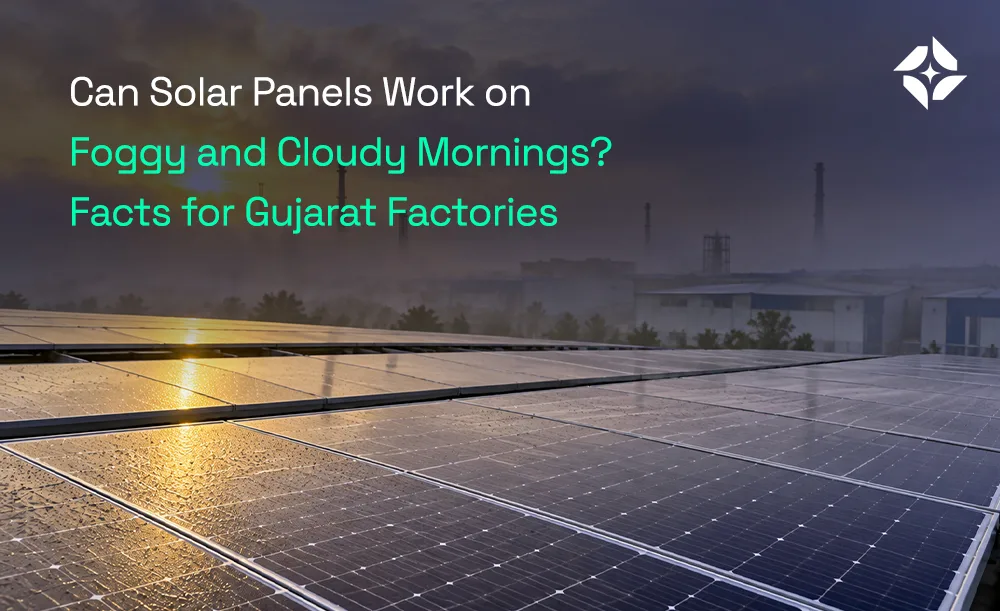
Solar photovoltaic (PV) modules convert sunlight into electricity. They can use both direct sunlight and diffuse sunlight scattered by the atmosphere. When fog forms, tiny water droplets scatter light and can reduce the sunlight reaching the modules. As a result, the installation may continue generating electricity, but its output can be lower than on a clear morning. Solar panels work on foggy days, although their electricity generation may decrease depending on the fog’s density.
The amount of electricity generated depends on the density of fog, the duration of the foggy period, cloud cover, and the site’s sunlight conditions. Light mist may have a different effect from dense fog that limits visibility. For this reason, factory owners should avoid using one fixed percentage to estimate output loss for every foggy day.
Research published in the Indian Meteorological Department’s journal MAUSAM examines solar radiation measurements collected across India. The study reports regional differences in global radiation, diffuse radiation, and bright sunshine hours. These differences support the need to assess solar conditions at the actual project location rather than applying one national estimate to every installation. Read the Indian solar radiation study.
How Fog Affects Solar Panel Efficiency and Output
Fog mainly affects the amount of sunlight reaching the solar modules. It does not automatically stop the modules from producing electricity. The resulting output depends on the atmospheric conditions and the design and condition of the installation.
1. Light Fog and Dense Fog Have Different Effects
Light fog may allow enough sunlight to reach the modules for continued electricity generation. Dense fog can reduce the available sunlight more severely, particularly when visibility remains low for an extended period. If clouds are also present, the combined conditions may reduce output further.
Factories should assess the actual weather and generation data instead of assuming that every foggy morning produces the same result. Two mornings with similar temperatures may produce different amounts of electricity because their sunlight conditions differ.
2. Fog and Cloud Cover Are Not the Same
Fog consists of tiny water droplets suspended near the ground. Clouds also contain water droplets or ice crystals, but they form at different heights in the atmosphere. Both can reduce the sunlight reaching solar modules, although the effect depends on their thickness, coverage, and duration.
Haze and airborne particles can also affect sunlight. An Indian government report from the Ministry of Science and Technology describes research on how aerosols, dust, and clouds can reduce solar energy generation from photovoltaic installations. Read the Press Information Bureau report.
3. Why There Is No Fixed Output-Loss Percentage
A statement such as “fog reduces solar output by 30%” should not be applied to every factory unless the figure is supported by relevant measurements and conditions. Fog density, local weather, module orientation, shading, and the duration of low sunlight can all change the result.
A more useful approach is to compare actual generation with an expected output estimate for the same installation. This helps distinguish a weather-related reduction from a possible equipment or maintenance issue.
Solar Panel Performance on Foggy Winter Mornings in Gujarat
Factories in Gujarat should use local weather information when estimating the effect of winter fog. Conditions in Surat may differ from those in northern India, where dense winter fog can persist for longer periods. Estimates taken from another region should not be applied directly to a Gujarat installation.
The India Meteorological Department provides a long-term climatological table for Surat covering 1991–2020. Factory owners and project planners can use local weather records as part of their site assessment. View the IMD Surat climatological table.
What Factory Owners in Surat Should Know
A factory in Surat may experience a foggy morning on some winter days, but the effect on annual solar generation depends on how often such conditions occur and how long they last. A short period of low output may have a different annual impact from fog that remains for several hours on many days.
Factories in Vapi, Ahmedabad, and other parts of Gujarat should also use location-specific weather and generation estimates. Local records, available site data, and the proposed system design provide a more reliable basis for planning than a general statement about winter conditions.
Why Annual Generation Matters More Than One Morning
Solar output changes throughout the day and across the year. A low reading during a foggy morning does not, by itself, show that the installation will produce less than expected over a full year.
For an industrial project, the assessment should examine estimated annual electricity generation, expected seasonal variation, and the factory’s consumption schedule. This helps owners understand the likely contribution of solar to their electricity needs.
How Much Electricity Can Solar Panels Generate During Fog?
There is no universal answer because the available sunlight varies from one foggy morning to another. Solar panels work on foggy days, but the amount of electricity generated depends on the sunlight reaching the modules. A useful assessment combines the installed capacity with measured or estimated sunlight conditions and the expected performance of the system.
Factory owners should understand the difference between kilowatts (kW) and kilowatt-hours (kWh). Kilowatts describe the rate of electricity production at a particular time, while kilowatt-hours measure the amount of electricity generated over a period.
An Illustrative Example
Suppose an industrial solar installation has a rated capacity of 100 kW. On a clear morning, its instantaneous output might reach 70 kW under a particular set of conditions. During a foggy period, its output might be lower.
The 70 kW figure is only an illustrative example, not a forecast for a specific Gujarat installation. The actual output during fog cannot be calculated from rated capacity alone. It requires information about the sunlight reaching the modules, module temperature, inverter operation, and other site conditions.
For a useful comparison, record the following information:
- Installed solar capacity in kW.
- Actual inverter output at regular intervals.
- Total daily generation in kWh.
- Local weather conditions during the recorded period.
- Expected generation from the system design.
- Any alarms, shutdowns, or maintenance issues.
Compare similar dates and operating conditions where possible. This provides a more meaningful view of how fog affects the installation than looking at one reading in isolation.
How to Review Solar Output on Foggy Days
Most monitored industrial solar installations provide generation data through the inverter or a monitoring platform. Factory staff can review hourly output, daily totals, and system alerts to understand performance.
If output remains unusually low after fog has cleared, check for other possible causes. Dust accumulation, shading, inverter alarms, damaged cables, or module faults may also affect generation. A qualified technician should inspect the installation if the monitoring data indicates a persistent issue.
Does Cold Weather Improve Solar Panel Performance?
Solar modules can operate more efficiently at lower cell temperatures, depending on their specifications. However, cooler weather does not guarantee higher daily electricity generation. If fog or cloud cover reduces the sunlight reaching the modules, the loss of available sunlight may outweigh the benefit of cooler operating temperatures.
This distinction matters when reviewing solar panel efficiency in winter. Module efficiency describes how effectively a panel converts the sunlight it receives into electricity under defined conditions. Daily energy generation also depends on how much sunlight is available and for how long.
Factory owners should therefore assess temperature and sunlight together. An installation may benefit from cooler module temperatures on a clear winter day, while a foggy or heavily overcast day may still produce less electricity.
How Factories Can Assess Solar Output During Fog
Industrial solar installations should be assessed using site-specific data. A structured review helps factory owners understand expected output and identify any issues that require attention.
1. Review Inverter Monitoring Data
Check hourly output and total daily generation during foggy periods. Compare the results with the system’s expected output and with days that had similar sunlight conditions. Keep a record of weather conditions so that recurring patterns can be identified.
2. Compare Expected and Actual Generation
The system design should include an estimate of expected generation. Factory owners can consult a provider offering solar EPC services to review site conditions, system design, installation, and commissioning.
3. Inspect for Dust and Shading
Dust and other deposits on modules can reduce the sunlight reaching their cells. Nearby structures, equipment, or new construction may also create shading. Inspect the modules and surrounding area according to the site’s maintenance plan.
Cleaning should follow the module manufacturer’s guidance and safe access procedures. Factory staff should not climb onto rooftops or handle electrical equipment without suitable training and safety arrangements.
4. Check Inverter Alerts and Electrical Connections
A fault or shutdown may reduce generation independently of the weather. Review monitoring alerts and arrange an inspection by a qualified technician if required. Electrical work should follow the applicable safety procedures and equipment instructions.
Practical Steps to Improve Solar Performance During Fog
For factories with sufficient open land, ground-mounted solar systems may be another option to evaluate, depending on land availability, project requirements, and financial feasibility.
- Use a site-specific generation estimate: Include local weather conditions and expected seasonal variation in the project assessment.
- Keep modules clean: Follow the manufacturer’s cleaning guidance and the site’s maintenance plan.
- Review monitoring data: Track hourly output, daily energy generation, and system alerts.
- Check for shading: Review nearby structures and equipment that may block sunlight.
- Plan energy use using measured data: Where production schedules allow, assess how daytime electricity demand matches expected solar generation.
- Review annual results: Compare actual generation with the project estimate over a suitable period before making conclusions about performance.
Adding more panels is not automatically the right response to low output during fog. First establish if the shortfall is caused by weather, system design, shading, maintenance, or an equipment issue. Any proposed change should follow a technical and financial assessment.
Industrial Solar Planning with Raynex Power Solution Pvt. Ltd.
For a factory considering industrial solar in Gujarat, the assessment should include local weather, available roof or ground area, electricity consumption, and the operating schedule. These details help establish an expected generation profile and estimate how much solar electricity the factory may use directly.
Raynex Power Solution Pvt. Ltd. provides solar solutions for industrial, commercial, ground-mounted, and residential applications. A project assessment should clarify the proposed system capacity, expected annual generation, design assumptions, and monitoring arrangements. This information helps factory owners make decisions based on their site’s requirements rather than a generic estimate of fog-related losses.
Planning an industrial solar installation for your factory?
Contact Raynex Power Solution Pvt. Ltd. to discuss your site’s requirements.
Conclusion
Solar panels can generate electricity during foggy and cloudy mornings, but the amount depends on the sunlight reaching the modules. Dense fog may reduce output, while cooler module temperatures can have a separate effect on electrical performance. Neither factor alone determines the total energy generated during a day or year.
For factories in Gujarat, the most useful approach is to combine local weather information with a site-specific generation estimate and actual inverter monitoring data. This helps businesses understand seasonal variation and make informed decisions about industrial solar capacity and electricity use.
Frequently Asked Questions
Can solar panels generate electricity during fog?
Yes, solar panels work on foggy days because some sunlight may still reach the modules. Output may be lower during dense fog because less sunlight reaches the cells. The actual result depends on the weather and the installation.
How well do solar panels work in dense fog?
Solar output may fall considerably during dense fog, but the amount varies by location and conditions. There is no single output figure that applies to every system. Monitoring data provides the best way to assess the result at a particular factory.
Does fog damage solar panels?
Fog itself does not normally damage properly installed solar modules. Solar equipment is designed for outdoor use within its specified environmental limits. The installation should still be inspected and maintained according to the manufacturer’s instructions.
Can industrial solar panels work during winter fog in Gujarat?
Yes. Industrial solar panels can continue generating electricity during winter fog when sunlight reaches the modules. The amount generated depends on local conditions, fog duration, and system performance. Factories should use local weather information and actual generation data when estimating seasonal output.
Do rooftop solar panels work on cloudy and foggy mornings?
Yes. Rooftop solar panels can generate electricity under cloudy or foggy conditions, although output may be lower than on a clear day. The amount depends on the sunlight reaching the modules and the installation’s operating condition.
Should a factory increase its solar capacity because of fog?
Not without a technical assessment. The factory should first review local weather records, expected annual generation, consumption patterns, and actual monitoring data. Additional capacity should be considered only after checking the system design, site limitations, and financial case.